Wednesday, August 27, 2014

Book Review, Groping for God


Groping for God

CBM eBook

Reviewed By Valerie Rouse for Readers’ Favorite

Groping for God is a personal, heart-wrenching story about Pastor Matupit Darius from Rabaul in Papua New Guinea. Pastor Darius lost his daughter Martina in a tragic bus accident. Pastor Darius was forced to escort Martina’s body to the hospital. All the while, he was in a state of deep shock. He couldn’t believe that a few minutes ago, he and Martina were laughing, enjoying themselves. Suddenly, their bus was tumbling down a ravine, killing his only daughter. According to author Darius, he (Darius) was so accustomed to extending support to his church members in their time of need. He felt out of sorts now that he was on the receiving end. He was accepting telephone calls and condolence greetings from friends and even strangers. Pastor Darius had to struggle emotionally to maintain a sense of equilibrium. He was angry with God for taking Martina, yet he knew and believed in God’s promise that He would not allow His people to bear burdens that they could not handle. He realized that he had to immerse himself in God’s word, especially the book of Job, in order to be at peace.

 Groping for God is a short novel outlining the grieving process experienced by Pastor Darius. The language is simple and colloquial. It is easy to understand. The book is written in the first person. This tactic essentially allows the reader to become fully immersed in the story. I love the inclusion of the photos. This enhances the dramatic effect of the tragic circumstances. The reader is inclined to empathize with the author and feel his pain. Author Darius utilizes bold blue sub-headings which are very effective because they assist in formatting the story. They also keep the reader in tune with the thought patterns of the main character. I also appreciate the various short questions interspersed in the book. This allows the reader to identify with the main character and experience the changing states of raw emotion. The use of contrast is clever. The story begins on a somber note yet, at the end, author Darius relates that his faith in God encourages him to put things in perspective. He can see that God is still in control, despite his loss. In essence, he found the silver lining under his dark clouds. I recommend this book to all readers who are going through trying times and need spiritual upliftment.

Wednesday, July 16, 2014

Reviews Appreciated

Hello Reggie,
 
I finished reading the Onesimus book you gave me at Northgate a couple weeks ago.  I read it pretty carefully over a period of a week or so.
 
I was very blessed by how much thought and teaching there is available in the very small book of Philemon.  And I really appreciated the segments on the history and culture which provides the backdrop for Paul’s letter.
So kudos to you and the other authors; the book is very well done for the person who really wants to dig into the Scriptures.  I also appreciated the straightforward direct manner of writing – not much clutter and plenty of thought-provoking information and observations.  I also liked the layout of dealing with the story “on the surface” and then having a follow-up section of deeper understanding.
 
One thought that soon became paramount in my mind was that if there is that much to be gleaned from a single page of Scripture, I can only imagine how much more there is from all the rest of Scripture.  That’s pretty exciting actually, and I couldn’t help but think that (at least) my more full comprehension is going to have to extend well into eternity, and in fact I wouldn’t be surprised if God’s Word will be continuing relevant throughout all of eternity. (Sorta puts into perspective the notion that God’s Word will never pass away!)  

Friday, March 7, 2014

Human Resource: Our Great Wealth

 
Foreign governments and companies are attracted to Papua New Guinea like magnets because of the great wealth they find here: fish, logs, oil, natural gas, copper, gold, copra, cocoa, palm oil, crocodile skins etc. etc. etc. But the real wea...lth of this incredible nation is its human resource. The most beautiful part of this beautiful land is its beautiful people!

Part of that human resource that no one knew about is the writing talent that is here. Here is a second book by Leslie Mamu, author best seller of Living Your Dreams. It is going off to the printers next week. What a joy.

Thursday, November 28, 2013

Jesus Has Defeated Satan


This book is not written by a Papua New Guinean, but it certainly is a very PNG book. Missionary Neville Bartle (like many missionaries to PNG) went to school when he arrived in the country many years ago. This schooling was not in a classroom with teachers and assignments; it was in villages, in bush houses, listening to late night stories around the fire. It was on long walks, canoe rides, etc. as he got to know hundreds of people and learned of their lives and stories. He learned many of these things from PNG people, but the truths are not local, they are worldwide. consider what he writes in the introduction:
- - - - - - - - - - - -
 Today there is a brutal, vicious, worldwide fight going on. It is not between families or clans; not between countries or provinces. It doesn’t centre around political differences or divergent worldviews. It is nothing new; it has been raging for millennia.
This fight is between God and Satan, between God’s holy angels and Satan’s evil powers of darkness.
This fight involves every human being and every spirit. It cannot be avoided. You and I are also included in this fight.
- - - - - - - - - - - -
 
 So many people wander their way through this warfare half blind. They get injured and crippled without even realizing how and why. It is time for Lasik surgery for our Spiritual Eyes. Time to see things for what they really are. Time to find victory - genuine life-changing victory - through knowing the Lord Jesus Christ.
 
Now available on eBook through the following outlets:
Amazon                                               Nook

Apple                                                  Sony

eSentral                                               Scribd

Kobo                                                   PagePusher

Monday, October 14, 2013

Groping for God

My Search for Answers During My Sorrows

We may rarely find someone who truly understands their personl journey through tragic sorrow. It is even more rare when that person is able to articulate that journey, and make it comprehensible, so that it might act like healing ointment for others to read, to feel, and to understand.

This is what pastor Darius has done for us.


Pastor Darius is from the South Pacific Island country of Papua New Guinea. He lost his wife through cancer and now his only daughter through a tragic accident. After comforting hundreds of mourners in his years of ministry, he now feels hurt, angry with God, and unable to recover. His honest story has helped thousands of readers in his own country.

Now his dynamic, true account is available worldwide in eBook format.


Amazon                                                        eSentral

Apple iTunes                                                Sony

Nook                                                             Scribd

Kobo                                                           

The price is only $0.99, have a look and spread the word.

Thursday, September 5, 2013

Invitation

By opening the pages of this book you are about to jump into a story, a fascinating story, a true story.
This story will take you to places you have never been before. It will introduce you to people you may know very little or nothing about.

BUT
You will be gripped by it. You will feel many different emotions – sadness, joy, fear, hope, empathy, tears, respect, etc. – for the people in the story and the situations they find themselves in. Bad things and good things have combined together to create a very difficult and conflicting situation. A situation that certain people are attempting to resolve.


We cannot know if Demas (as an example) really was talkative and outgoing. We don’t know if Dr. Luke worked in a hospital. We don’t know how the runaway slave met up with Paul who was under house arrest. But we crafted this story as a way to show how it could have happened. We tried to be true to the surroundings and time-period of the original story and we have attempted to be true to all the information the Bible does give us about the characters and the events concerned.

Thank you,
The Authors

Friday, August 16, 2013

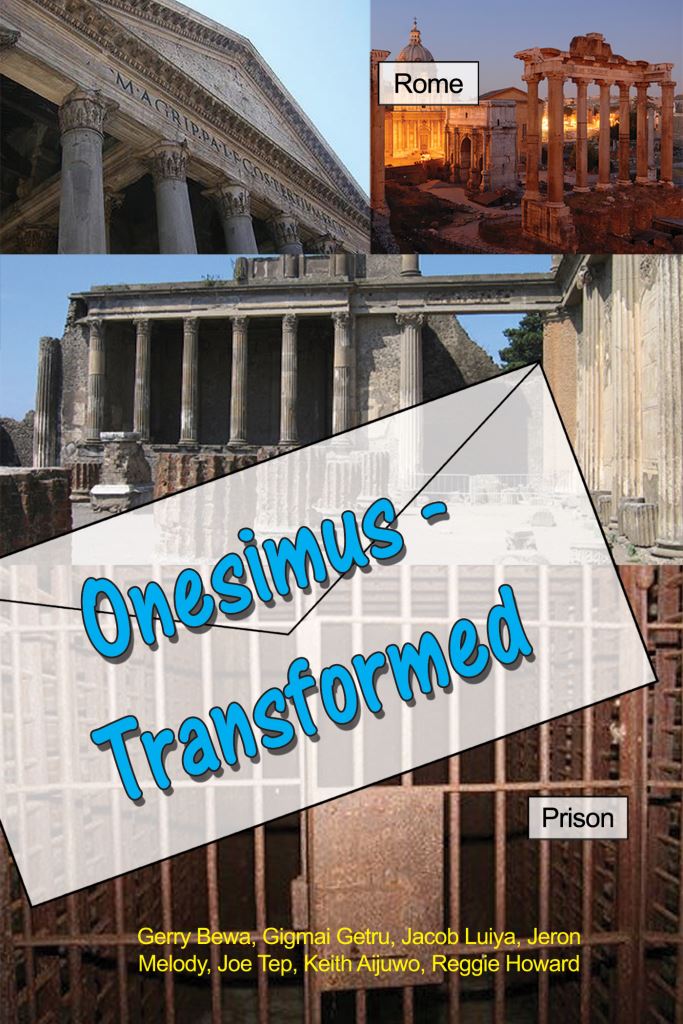
Onesimus - Transformed
This is an incredible book; fun, informative, enlightening.


This is
Creative Biblical Writing.

Saturday, February 23, 2013

How "creative" can nonfiction be?

It is time for the Oscars and this year apparently three nonfiction movies are being examined in regard to their truthfulness toward the events they portray. This has created discussion in many arenas. One incidence is the film "Lincoln." Apparently the film has representatives of the state of Connecticut opposing a motion to free slaves and apparently this is completely untrue to the facts.


I came across this book in the local library a day or two before the Oscar discussions popped up. The title intrigued me so I pulled it off the shelf and gave it quick read-through. It is based on a real situation where the first author wrote an essay for a magazine that was quality writing but the author fudged on a number of the "facts." The second author was called in with his fine-toothed-comb to see if it could be salvaged enough to be published.

The book is interesting, funny and enlightening. There is almost no introduction, no conclusion. The pages are laid out with portions of the essay centered in the middle, and the questions and comments of the fact checker along with interactive correspondence with the author and the fact checkers boss. It is quite an accomplishment to make such material, with such a layout, an attention keeper.

I have wondered with the Josiah book and the Onesimus book if readers might feel uncomfortable about seeing sacred texts turned into lively stories (the liveliness especially true with Onesumus). I hope readers feel free to pass on any critiques of the material.

If we have presented anything contrary to the original documents we would certainly like to know. It seems, though, that the creative presentations have oiled many readers' rusty minds and inspired them to further study. This is the goal and reward of such writing.

Tuesday, February 19, 2013

Wily


The Bible has some wily characters, but the chief of the bunch might just be our old friend Jeremiah.
 
He is tenacious, witty, and quick with a comeback. He was frustrated with a weak and waffling disobedient king, who simply would not heed the clearest warnings that he needed to surrender to the enemy in order to save the temple, the city, and the nation. So to get his point across, he came up with this line to stress the inevitability of defeat.

"Even if you were to destroy the entire Babylonian army, leaving only a handful of wounded survivors, they would still stagger from their tents and burn this city to the ground!" Jer. 37:10 NLT
There are tons more of these.

Friday, February 15, 2013

Josiah - Chain Breaker

The first eBook by Christian Books Melanesia is now available through Kindle, iTunes, Nook and Kobo (and some others). Yippee! The title: Josiah - Chain Breaker. Price: $1.99.

Josiah - Chain Breaker

Kindle:

iTunes:

Nook:

Kobo:


Monday, January 7, 2013

De-isolate The Events and People

How many Bible readers know where and how the Prophetic books (Isaiah - Malachi) intersect with the historical books(1 Kings - Esther) and with the other prophetic books. This is a gold mine of study and facinating.

Wednesday, December 19, 2012

Author Training Industry

There are a lot of people and organizations that make a living off of peoples' dreams to become a published author. There is nothing wrong with the dream, and there is nothing wrong with wanting to help people fulfill their dreams. But promises are made, by individuals and organizations, that they may not be able to deliver on. So the aspiring writer needs to use discernment when spending money on developing their trade.

One very good resource is this book:  Planning out a book from front to back is not everyone's way of writing, but it is good to see how it can (and reasons why is should) be done.

Tuesday, October 30, 2012

I Found It

I am a firm believer in the value of historical fiction. It is an effortless way for the reader to learn some valuable history and its attendant lessons. This learning is effortless because the story is captivating in itself and perhaps worth reading even without the true parts. But the historical settings and events and people make it that much more worthwhile.

I gained a lifelong interest in the modern nation of Israel (and even made a trip there) by reading The Zion Chronicles by Bodie Thoene. My best friend learned her US History by reading The House of Winslow series by Gilbert Morris. And now I have found some good historical fiction based on Biblical history (I have been disappointed by many other attempts). I was able to download to my Nook a free eBook by Lynn Austin, the first of a five book series called Chronicles of the Kings.
 

Mrs Austin weaves a captivating storyline while informing us about a whole lot of historical, Biblical truth. She did her homework and got things right. Learn about King Ahaz. Learn about King Hezekiah. Learn about Prophet Isaiah. Learn about Prophet Micah. Learn about ancient Judah and Jerusalem. Learn about the Arameans and Assyrians, about water and sieges and vassals and treaties. More than that, learn about the way God dealt with his wayward people. What he expected and how he responded to the choices of his people. Learn about sin, repentance, forgiveness and restoration. Learn all these things without even trying to. That is what good historical fiction can do. Thank you, Lynn Austin, for giving a good example of what I am looking for.

Reggie H.

Friday, September 7, 2012

Below the surface

 
Are we satisfied too quickly in our study of the Living Word? Do we note most of the surface features of a story but not look deeper to find its full purpose and message? If so, this is a grave loss (and failure) on our part.

The following is a study on the very familiar story of Jesus at 12 years old. Have we caught the point (or points)? We need to do better.

Monday, June 18, 2012

Hard Work

Writing, at times, can be hard work. Especially when it is audience oriented rather than self-expressive oriented. I would love to write about the three girls in my life. To know these girls well is to know that there is an incredible creator who has instilled life and vitality and imagination and a myriad of other good qualities in his creatures. I am too busy, too distracted, too worn out to do justice to the subject of describing these three. Maybe some day.

Thursday, May 24, 2012

A Portal to Insight

Creative Nonfiction is a handy portal for entering into an obscure or difficult-to-appreciate historical event, and thereby understand and appreciate it in a new and greater way.

The following series of articles is an attempt to illuminate a passage of the Bible that most people are unaware of. It starts with a front page newspaper article stating the facts (in a somewhat biased way) of the incident, followed by three very different letters to the editor (which should balance out some of the bias). These are then followed by a reminiscence of the perpetrator of the events, then things conclude by a summary from above.

May you be drawn into this historical event and be motivated to explore it further. Bible references are included in brackets.

The link is here  The Reluctant Landowner

God bless, Reggie H.

Tuesday, May 8, 2012

The Beautiful, Multi-complexity of Language

No other human activity is as involving and complex as language communication[1]. We can say anything we want, the sentences we spin  “off-the-cuff” throughout the day in all sorts of circumstances, emotional states, relationships… are appropriate works of creative art.  We talk to each person a little differently, we have a dialect for speaking to one child, a slightly different dialect for talking with another, a different dialect again for our spouse, parent, boss, pastor, policeman, etc., etc., etc.,  switching back and forth constantly without giving it a conscious thought[2].  We develop new sentence patterns.  Use words in new contexts, stretch their meanings[3], make metaphorical associations at the drop of the hat.  Then there are the innuendos, the undercurrents, the overtones, the unspoken implications, etc. etc. etc.  Language is a powerful tool in the hands of a fluent user.
One of the disadvantages of linguistic research is that laboratory findings can only be understood and explained to others by use of its own specimens (using language to explain language).  No other science is like this.  Also, not only are the specimens “out there” for laboratory research, but they are also, in all their infinite variety, crammed in the researchers’ own heads, always asking for more examples, further insights, possible exceptions.  This can drive one dizzy.
Out of a normal vocabulary of say 60,000 words, we can spin an infinite variety of sentences.  Out of the infinite variety of sentences there is no limit to the discourses we can create of any subject, any size, for any purpose. Yes.  Human language is complex beyond description, and there are over 6000 different languages, all doing the same work, fulfilling the same functions, using different vocabulary, syntax, semantic structures …  No wonder the field of linguistics has yet to fully conquer its territory.
A sub-branch of linguistics is Discourse Analysis.  DA studies whole discourses with all their parts.  It is a progressing field of study, with noticeable gains year by year.  Its lack of definitiveness is due in part to its subject matter.  Not only is language infinitely complex, but it can be approached in a variety of ways. Individual facets of the language scheme are scrutinized one at a time (like function, modality, semantic hierarchy, etc).  Any framework wide enough to include everything would be too cumbersome to handle.  Humans can theorize about language, debate about language, but language is bigger than our processing systems.  Language is something we use far better than we understand.[4]


[1] "With the God of the scriptures at the center of our world view, language takes its place in God's creation along with man who speaks it. For the Biblical theist it is instinctive to espouse a high view of language and its categories.  Whatever the ultimate nature of the universe, God, in giving us language (or letting us develop it) has not duped us.  He has given us a quick and ready means of indexing things, finding our way around, and having practical insight into reality.  Whatever there is that is ineffable about matter and spirit, language at least gives us an open-ended way of grappling with it.  And just as no one can dogmatize about the limits of the physical accomplishments of man's body (with e.g., new athletic records being set all the time), so no one can intelligently dogmatize on the limits of language.” Longacre, pg 354.
[2] Halliday on register is related but not the same.

[3] “Words, then, are ‘slippery’ things.  They shift, sometimes almost imperceptibly, sometimes more dramatically, in the course of time.  ‘Time’ here can be a century in the life of the language, or twenty years in the career of a writer.” Carney, pg 85.

[4] “Language presents its skilful user with boundless resources.  Its major terms have layer upon layer of meaning.  Skilfully combined, these become phrases resonant with halftones, undertones, overtones and echoing reminiscences.  Skills in producing word magic are far better developed than those in analyzing it.” Carney, pg 50.

Tuesday, May 1, 2012

Foreign Elements

How do you explain things that reside far outside of your readers’ experience? Some cultural and religious practices are so foreign to our experience. Some things in the Bible are very much this way. Some things we can be very happy to be ignorant about, one of them was the abominable practice of child sacrifice.

How do you get such things across when the situation requires? Be creative.
An example of this can be found right here: Gone, Completely Gone.  This is a chapter from the book Josiah – Chain Breaker; An example of true collaborative writing by men and women in Papua New Guinea.
Enjoy.

Tuesday, April 24, 2012

Depth Derived from Experience


I am convinced, and I say it in my correspondence and teaching of aspiring writers, that the best and most effective writing comes not just from study and thinking, it comes from genuine experiences in the arena of life and ministry. Depth comes from experience, from processed experiences. There are many things that I don’t feel qualified to write about because I still have too much to learn. Three of them are:
  1. Marriage and Child rearing.
  2. Spiritual Warfare.
  3. The book of Revelation.


I still have way too much to learn in these areas. However, I wrote up an outline of thoughts and ideas on the second one. It is a study from Ephesians 6. It can be read right here: Survival in the War Zone.

Tuesday, April 17, 2012

Collaborative Writing


There are very few people of Papua New Guinea who can sit down and write a book. But, get a few of them together working on the same project as a workgroup, and ideas fly like sparks from a grinder; words flow like water from a tap; and great writing can take place. This is what I believed a year ago, and this is what I have seen come true. One book is completed, Josiah – Chain Breaker, and another one, Onesimus – Transformed, almost so.
Excellent writing by some great people. Excerpts to follow at a later date.